TWO:In the manufacture of iron a most material discovery of smelting the ore by the use of pit-coal was made. The forests of England were so much reduced by the consumption of wood in the iron furnaces, that it was contemplated removing the business to our American colonies. This necessity was obviated by the discovery by Dud Dudley of a mode of manufacturing bar-iron with coal instead of wood. This discovery had been patented in 1619, yet, singularly, had been neglected; but in 1740 the principle was applied at Coalbrookdale, and iron thus made tough or brittle, as was wished. Iron works, now not confined to one spot by the necessity of wood, sprang up at various places in England and Wales, and the great works at Rotherham were established in 1750, and the famous Carron works in Scotland in 1760. The quantity of pig-iron made in 1740 was calculated at 17,000 tons, and the number of people employed in the iron trade at the end of this period is supposed to be little short of 300,000.
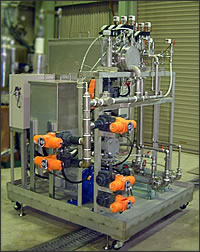
A hydrocyclone (liquid cyclone) injects treatment solution into stationary equipment to perform separation, classification, and concentration, and is an innovative separator with a very simple structure and no drive unit.
Structure of a hydrocyclone (liquid cyclone)
A suspension containing fine particles of several micrometers or more is supplied to a cylindrical container circumferentially at high speed. And as a result it starts to rotate and a centrifugal force is generated. At this time a gravitational acceleration of several tens of thousands of G is generated in the circumferential direction, and thus leading to fast sedimentation and concentration of the fine particles. The separated concentration can be freely selected by changing the supply rate (supply pressure and flow rate) and the flow ratio of the outlet. Our hydrocyclone (liquid cyclone) was designed and manufactured to classify and concentrate fine particles, and so has a small element.
THREE:Comedy and farce occupied the middle portion of the reign, but neither of them rose to the height of Sheridan. In tragedy, Murphy's "Arminius," Godwin's "Antonio," and Madame D'Arblay's "Edwy and Elgiva," were the best. Amongst the comedies, Holcroft's "Road to Ruin," Morton's "Speed the Plough," Mrs. Inchbald's "Wives as they Were, and Maids as they Are," and Colman's "Sylvester Daggerwood," were the most popular.
- Equipment costs can be reduced.
- Operating costs can be reduced.
- Maintenance costs can be reduced.
- Any change in raw material and product can be easily addressed.
- Large amounts can be treated in a small area.
- Separation and cleaning are easy because of the simple structure.
- Simplified control
- This equipment can be operated in synchronization with external devices.
- Alarm and interlock mechanism.
THREE:The agitation extended to England, where also the "No Popery" cry was effectually raised. The Duke of Newcastle, Lord Winchilsea, and Lord Kenyon led the way in the formation of Brunswick Clubs. A great demonstration was got up on Penenden Heath¡ªa monster meeting of English Brunswickers. To counteract its effects, it was determined that some of the leading advocates of the Catholic cause, being freeholders of Kent, should go to the meeting. Among those who attended were Lord Darnley, Mr. Cobbett, Serjeant Shee, and Mr. Sheil; but none of them could obtain a hearing. Mr. Sheil had come prepared with a grand speech, carefully written out, as was his custom, and committed to memory, but not so strictly as to exclude such extemporaneous additions as might be necessary to adapt the oration to the actual circumstances. When he arrived at the meeting, the reporter from the Sun asked him for his manuscript, which he gave, with the understanding that he must make it correspond with his speech as delivered. The reporter, taking it for granted that it would be delivered all right, made all possible haste to get it into type. The speech appeared in extenso; but it unfortunately happened that, owing to the uproar and continued interruptions, it was not delivered. The circumstance became the subject of remark, eliciting comments by no means flattering to the Irish orator. The intended speech, however, was as able as any he had ever delivered. It consisted chiefly of an elaborate defence of the Roman Catholic Church from the charge of persecution. It admitted that it did persecute like every other church when in power; but that it was an incident of its establishment, not the natural result of its spirit and principles.
- Classification and concentration for the manufacture of inorganic powder materials
- Classification of ceramic materials
- Removal of fine particles, including iron powder
- Removal of fine particles from pigments
- Removal of fine organic particles from solvents
- Separation of starch and yeast
- Removal of fine particles from high-temperature strong acid solutions
- Removal of fine particles from low-temperature solutions